
What I Released This Week
- Iran War: Trump TACOS Again Or Does He? Saudi Airports Blasted Again — Naked Capitalism, 9 Oct.
- Another Epically Bad News Cycle for OpenAI, The Amoral Money Abyss — Naked Capitalism, 8 Oct.
- Iran War: Iran Ups the Ante in the Gulf, Ansar Allah Blasts Saudi Airports, Trump Threats — Naked Capitalism, 8 Oct.
- Meta Makes Its Agentic AI Move With Muse — Naked Capitalism, 7 Oct.
- Iran War: The Real and Narrative Battle for Mocha, Saudi Airports Hit — Naked Capitalism, 7 Oct.
- Jasmine Crockett and the Dick Cheney Wing of the Dem Party Have All Got to Go — Ian Welsh, 6 Oct. (Crossposted at NWT.)
- Ellison Empire Settles on Skydance, Takes Big Bond Price Hit, Names Team — Naked Capitalism, 5 Oct.
- Iran War: Team Trump at Camp David, Iran Flexes, Riyadh Burns — Naked Capitalism, 4 Oct.
From me as Nate Wilcox at the Let It Roll Podcast
- This week’s From the Beginning episodes cover a fascinating period in American musical history, the era that participants called “The Jazzed Age” but which featured very little music that today’s critics call Jazz. Nonetheless, it was a thrilling time of transformative technologies (radio, microphones, electric recording), sudden global cultural dominance in the wake of World War 1, and the emergence of great talents like Bessie Smith, Louis Armstrong, and Bing Crosby.I have some gaps to fill here and hope to cut more episodes on Louis Armstrong, Sidney Bechet, Bessie Smith, and Blind Lemon Jefferson in the future.
- Record Men From Thomas Edison to John Hammond & Chris Blackwell: Let It Roll From the Beginning… 4.2 — Let It Roll, 9 Oct.
- Bing Crosby’s Swing Brought Him Superstardom: Let It Roll From the Beginning… 4.1 — Let It Roll, 7 Oct.
- The Pop Jazz Age From the ODJB to Bing Crosby: Let It Roll From the Beginning… 3.12 — Let It Roll, 5 Oct.
From me as Nate Wilcox — The MMA Draw & the Mad Squabbles Show
- What Ari Emanuel’s ‘Roll the Calls’ Memoir Leaves Out — The MMA Draw, 7 Oct.
- Cheap Shots: FBI Snitches, Scams, Saudis and the Secret Sheik — The MMA Draw, 3 Oct.
UFC Boss Brags About Backstabbing Vince McMahon — The Mad Squabbles Show (YouTube), 7 Oct.
What I’ve Been Reading and Watching
AI Bubble
- A.I. Groups Are Spending Millions to Influence the Midterms — New York Times. “A New York Times analysis of federal campaign finance data shows that the political groups aligned with the two leading A.I. developers, OpenAI and Anthropic, have quietly but decisively intervened in key 2026 races, spending on campaign advertising and outreach to voters to the tune of $55.7 million.
“So far, the spending has been concentrated almost entirely in the primaries. The two groups have spent $52.6 million on safe seats — those that are unlikely to change party hands but that often feature intense intraparty contests. The big A.I. players have also spent more heavily for Democrats than Republicans. They have boosted candidates who align with their agendas, helped defeat those they see as hostile to it and ingratiated themselves with front-runners who are likely to be in positions of power in the next Congress to make decisions critical to their bottom lines.
“But with voters quickly souring on their industry — including demanding that lawmakers do more to regulate A.I. and halt or mitigate the proliferation of data centers — they have taken pains to obscure their involvement. With few exceptions, they have intervened without ever explicitly mentioning A.I. or data centers in the TV and digital ads they have purchased.” - The Empty Brain — Aeon. Your brain does not process information, retrieve knowledge or store memories. In short: your brain is not a computer.
- Timnit Gebru Believes There Is No ‘Existential Threat’ From AI — Wired. One of AI’s fiercest critics believes the doom talk is about founders making money, not saving humanity.
- Are Big Tech bonds crowding out the US Treasury? — Financial Times.
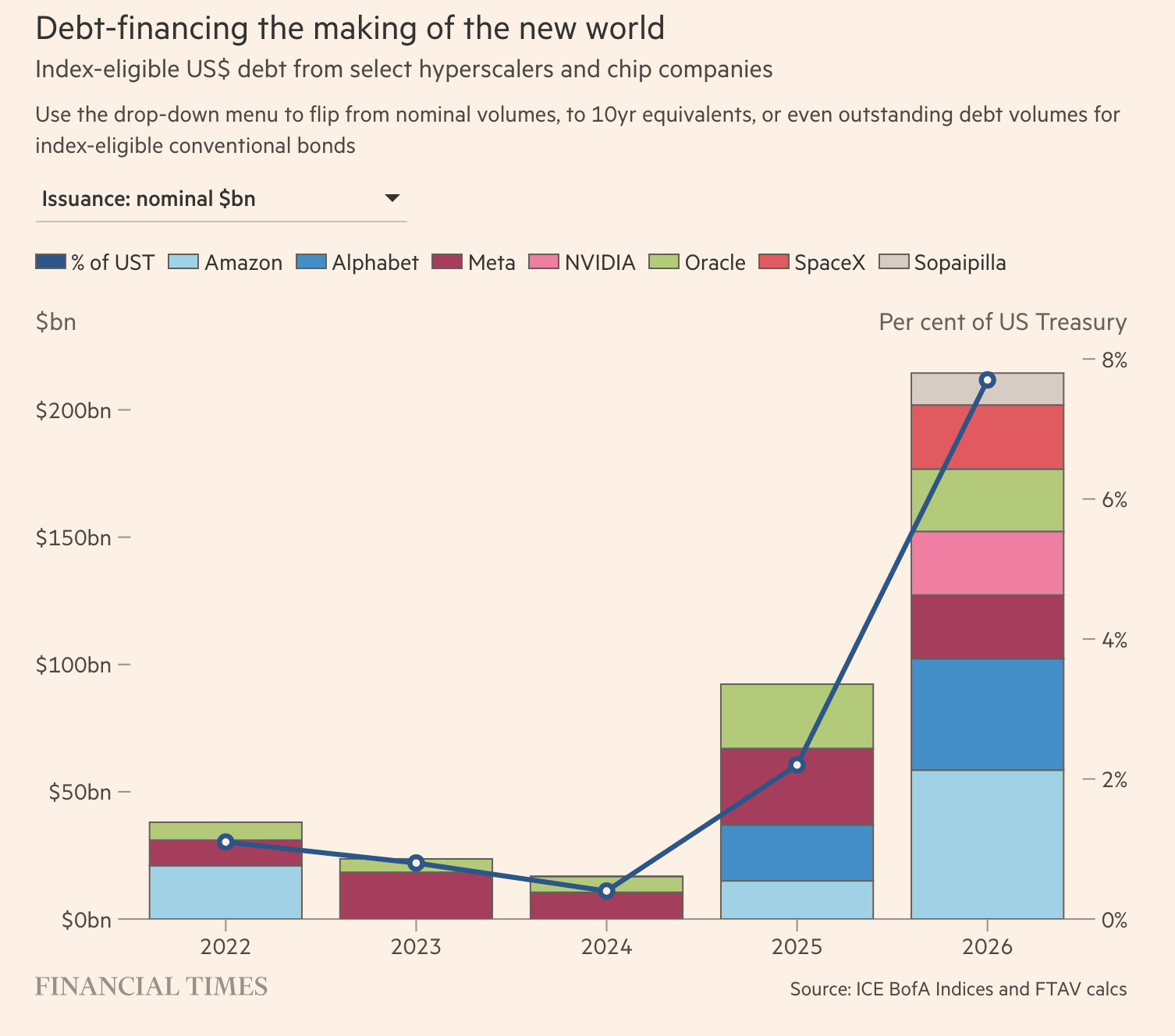
- The AI Cloud Oligopoly — Michael Burry. “I have recently considered that the tech giants, but for Apple, are spending as if their lives depended on it when their lives clearly do not.
“Monopolies almost by definition need not spend wildly as if their lives depended on it.
“This deserved no small further contemplation, although rather quickly it dawned on me that they expect this just to be another monopoly rent they collect, that they collectively have the expectation the government will tolerate their oligopoly on AI.
“Nay, will tolerate and fear it.
“So the evil gambit is to create and to allow this AI to grow on their machines, where they will threaten to control both economic and political forces greater than humanity has ever seen, overwhelming any politician’s, or politicians’, might.
“Why are OpenAI and Anthropic and Oracle also spending so much? Surely they are not monopolies?!?
“No, but they intend to be part of the oligopoly. None can imagine breaking the dominance of a Microsoft, Amazon, Google, or Meta within each silo.
“However, there is clearly an opportunity to join in that dominance under cover of a new paradigm. The power and riches expected by these companies are evidently so great that even Larry Ellison was seduced to bet his company on it.
“This brings new meaning to technocracy, and whether such is what we face. What is really scary is that other than the grab for market power, all this spending does not have a defined goal or economic end-point. As such, the consequences are likely unknowable to all. Yet they do it anyway.
“The governments most interested in this technology seem to be the autocratic ones and the United States. A good set-up for a lot of drama, if not terror.”
Ellison Empire
- Looking at the Ugly Side of the Paramount-Skydance Merger…And How I’d Fix It — The Entertainment Strategy Guy. “More than one person sent me a note speculating that the big problem with Paramount Skydance buying Warner Bros. Discovery is the “Warner Bros.” portion of the deal. In fact, that’s a take I read a lot about Warner Bros., ever since they caught Netflix’s, and then Paramount-Skydance’s, eye. In short, multiple companies (Time, AOL, AT&T, Discovery) have bought and then regretted buying Warner Bros.
“if you want to add a traditional Hollywood studio to your portfolio (be it a magazine publisher, internet service provider, cellular phone company, linear cable bundle or rival movie studio), you have to convince the owners to sell.
“And that usually means overpaying. The opposing executive team has to want to sell, and then they have to clear it with their shareholders. Overpaying accomplishes this. (This is a variant of the winner’s curse in auctions.)
“So that’s the price of the deal. And usually it shows up on balance sheets as…
“Debt.
“Indeed, the history of Warner Bros. buyers is folks taking on wayyyyyy too much debt to buy the company. Servicing that debt cripples the new combined enterprise. And they can’t invest in new opportunities. And often they make bad decisions to help pay off that debt. Eventually, this impacts the stock price, so they sell. Then the cycle with Warner Bros. starts again!” - What David Ellison’s Latest Moves Say About How He’ll Lead Now — Wall Street Journal.
- A High-Stakes Gambit Clinched Paramount’s Warner Deal — Wall Street Journal.
- Ellison waged a concerted behind-the-scenes campaign, people familiar with the matter said.He crisscrossed the country courting politicians, hired well-connected operatives and lobbyists to work regulators and lawmakers, cultivated allies among Republicans and Democrats and, in a pivotal move, even threatened to move his empire out of California.California Gov. Gavin Newsom publicly called on the two sides to settle the matter, and privately encouraged the attorney general to go to the table. Ellison met with Newsom on more than one occasion, the people familiar with the matter said.
…
Next, Ellison had to get the deal through regulators here and abroad.That task fell primarily to chief legal officer Makan Delrahim, one of Ellison’s first hires after acquiring Paramount. Ellison set up a war room on the Paramount lot where he, Delrahim and one or two other executives would meet daily to map out strategy and measure progress, said one of the people familiar with the matter.A former Trump administration antitrust chief, Delrahim was intimately familiar with Warner. As head of the Justice Department’s antitrust division, he led the government’s ultimately unsuccessful effort to block AT&T’s acquisition of what was then called Time Warner, in 2018.One of Delrahim’s first moves was to tap Jon Leibowitz, who chaired the Federal Trade Commission under President Barack Obama, as an outside antitrust adviser.
Getting approval from the Justice Department came with relative ease, as did approvals from the European Union, United Kingdom, China and other regions.
But a hurdle emerged when California’s Bonta, joined by 11 other states, including New York, Connecticut and Colorado, sued to block the merger on antitrust grounds. The states alleged the deal would illegally consolidate markets including those for theatrical films and basic cable channels.
…
Meanwhile, Ellison and his team began making their case to Newsom and warned that Paramount would pack up and move to another state if the deal was blocked. The company spoke to officials in Tennessee about a potential move, The Wall Street Journal reported.While Bonta categorized those threats as bluster and blackmail, people close to Ellison said they were genuine. That message was conveyed to Newsom, the people familiar with the matter said.
In early August, Ellison tapped former California Assembly Speaker and Democratic power broker Fabian Núñez to help build political support for the deal in Sacramento.
Núñez, founder of the consulting firm Actum, met frequently with Bonta’s office in an effort to broker peace. Ellison also enlisted Democratic former California Sen. Barbara Boxer and former Los Angeles Mayor Antonio Villaraigosa to help, both of whom are partners with Actum, people familiar with the matter said.
- Ellison waged a concerted behind-the-scenes campaign, people familiar with the matter said.He crisscrossed the country courting politicians, hired well-connected operatives and lobbyists to work regulators and lawmakers, cultivated allies among Republicans and Democrats and, in a pivotal move, even threatened to move his empire out of California.California Gov. Gavin Newsom publicly called on the two sides to settle the matter, and privately encouraged the attorney general to go to the table. Ellison met with Newsom on more than one occasion, the people familiar with the matter said.
- Ari Emanuel Tours His Book and Hollywood Yawns: ‘No One Gave a F—k’ — The Wrap.
Hollywood didn’t bother to show up. A few rows up front were reserved for Emanuel’s friends and VIPs which consisted of some family members, his close pal, director Pete Berg, and some agents, according to one person who sat nearby. The green room had a small selection of friends, no more than 20, circulating afterward. The audience was made up of “civilians,” as one person put it, rather than the insider VIPs that Emanuel, as one of Hollywood’s most powerful players, should command.Just as well, though, because apparently Emanuel was really boring. He did not hold forth on the accumulated wisdom of his 40 years in the industry: building an agency, taking over a legacy rival, buying companies like the UFC and WWE for billions of dollars, pushing hard into live sports and going public and then private again.Instead, he fell back on his grievances with his previous longtime partner Patrick Whitesell, who he swears he will never talk to again; complained about Jeffrey Katzenberg and President Joe Biden; and parried Swisher’s probing about his friendship with Elon Musk. By all accounts, it didn’t land with an audience that wasn’t interested in these personal scores. - Paramount Stock CRUSHED After Merger with Warner Discovery Closes — Big by Matt Stoller.
The transition is not promising. Consider the two things that David Ellison did after buying Warner Discovery. He organized mass layoffs, and he gave himself and his entire executive team a big raise. Specifically, Ellison awarded himself a $150 million bonus upon closing the purchase, even though he doesn’t need the money, and has accomplished absolutely nothing except saddling two historic movie studios with $80 billion in debt.His legal consigliere, Makan Delrahim, received $25 million, and his operating officer Andrew Brandon-Gordon got $38 million. To do the layoffs, he hired Mattel CEO Ynon Kreiz, and paid him $46.5 million. That’s all on top of the massive $550 million payout to former Warner CEO David Zaslav, which was negotiated as part of the deal.Amid that backdrop of endless zeros for executives, the layoffs will be significant, and Kreiz and Ellison sent a memo on the “difficult decisions” ahead. That’s a crushing blow to morale, since it says very explicitly, “we’re not all in it together.” Every employee at Skydance has essentially been told to act like a mercenary and to extract as much as he or she can while he or she can.
UAE
- Khaldoon Al Mubarak is the man trying to pull City back from brink of football oblivion — The Telegraph. The Telegram fluffs Khaldoon. “It was November last year and City had just been beaten 2-0 at home by Bayer Leverkusen in the Champions League after Guardiola, as needlessly as inexplicably, made 10 changes to the team.
“Al Mubarak was furious and expressed as much privately to Ferran Soriano, the City chief executive. “I can’t speak to him [Guardiola],” he said. “Honestly, I didn’t speak to him yesterday and didn’t message him and I can’t speak to him today I’m so angry. He’s put a mix in this that’s so unnecessary.”
“But it was what Al Mubarak said next that cut to the heart of how one of the most powerful, influential and recognisable non-royals in Abu Dhabi likes to conduct himself.
““Let’s let this pass then we’ll talk about it in the right way with a constructive approach,” he said.
“Perhaps it should be little surprise that a skilled business leader and government policymaker who has played crucial roles in brokering nuclear non-proliferation deals and long straddled the worlds of global finance and international diplomacy was not going to let his heart rule his head and overreact.
“After all, you do not become the planet’s longest-serving head of a sovereign wealth fund and a key strategist by being a hot head prone to wading in with both feet when something irks you, even in a sport as emotive as football.” - A Soccer Cheating Scandal Has Ballooned Into a Geopolitical Problem for Britain — Wall Street Journal. The UK finds that selling your most beloved cultural institution to an amoral family fiefdom comes with strings. “The acquisition of Manchester City by an Abu Dhabi royal was always much more than a billionaire buying himself a shiny foreign toy.
“From the very start, the project was the tip of a soft-power campaign to entrench the tiny Emirate deep in the British economy.
“Now, 18 years later, it has emerged that the club was at the heart of the largest cheating scheme in English soccer history. And as City, which denies any wrongdoing, awaits an unprecedented penalty for financial doping, the scandal has rippled all the way to new Prime Minister Andy Burnham.
“The predicament is especially awkward for Burnham, who built much of his political appeal on his everyman soccer-fan image, but now finds himself caught between a major investor in the U.K. economy and defending the integrity of the Premier League, Britain’s most popular cultural export since the Beatles.
““This does need to be done carefully without everybody jumping in and providing their conclusions,” said Burnham, who in his previous job as mayor of Manchester lobbied against punishing his beloved Everton for similar, smaller-scale infractions.
“The U.K. has spent much of the past decade wooing the U.A.E. to invest in the country in an attempt to kick-start its slow-growing economy. A Sovereign Investment Partnership between the two counties, announced in 2021, initially targeting £10 billion over five years, has already seen nearly £30 billion committed across more than 50 direct investments.” - The chairman of scandal-hit Man City has worked with Trump and Macron as part of the UAE elite — AP. The UAE connects Trump, the Ellisons, Ari Emanuel’s TKO empire, and the UK in a web of corrupt dealings. “Khaldoon Al Mubarak, chairman of the scandal-plagued Manchester City soccer club, sat with Donald Trump in Davos this year, signing on to the U.S. president’s Board of Peace on behalf of the United Arab Emirates government.
“He was with French President Emmanuel Macron at the Palace of Versailles in June at a signing ceremony for a business summit.
“Al Mubarak, 50, also is a UAE special envoy to China, and welcomed Xi Jinping to the club when the Chinese leader visited England in 2015.
“Why the head of an English soccer club — albeit one of the wealthiest, most successful and now highly controversial — should be a key player at such political events is easily explained.
“Al Mubarak, the public face of the 2023 Champions League winner now embroiled in one of soccer’s biggest scandals, is a member of the ruling elite in Abu Dhabi — part of the United Arab Emirates — and the head of a $385 billion sovereign wealth fund.”
UK PM Andy Burnham on Man City — @BBCSport. “‘I haven’t downplayed the seriousness of the findings.’
“Andy Burnham has addressed concerns that he devalued the verdict against Man City after the club were found guilty of Premier League financial rule breaches.”
🗣️ “I haven’t downplayed the seriousness of the findings.”
Andy Burnham has addressed concerns that he devalued the verdict against Man City after the club were found guilty of Premier League financial rule breaches. https://t.co/2V1geGZhnQ
— BBC Sport (@BBCSport) October 8, 2026
Israel
- Nothing has changed, and everything is changing — Alon Mizrahi. “…since October 7, I avoided Israel as much as I could. And it hadn’t felt like my place and my home for a while before that. This didn’t begin on October 7. Nothing began on October 7. But since October 7,
“as I had a very early realization that this was a fateful event and life was not going to return to normal. And even more than that, and I shared this a couple of times, I had a very strong feeling that this was the beginning of the end of Israel
“and I needed to be somewhere else and I want my family to be somewhere else. And I did that. To make a long story short, I spent some time in Israel this year and also very recently. And this gave me a chance to look at Israel, to see Israeli society, to hear Israelis, to look at Israeli media.
“It’s not the same when you’re in and when you’re out. It’s not the same. It feels different. And since I really love to observe people and societies, this is one of my favorite things in the world to do, really. I took the opportunity to look and see. Not that I was expecting any surprises.
“I mean, this is Israel. After all, I grew up in it. I know it so well. It’s a society. It’s a… It is a political creation that doesn’t change. The discourse, the narratives, the beliefs, the talking points, everything is on endless repeat. Nothing ever changes and this is really a very clear sign of a manufactured identity.
“If you always say the same things and think the same things and react the same way and repeat the same talking points, no matter what happens in reality, it means that your very sense of self and reality and where you come from is false. Because in real life, you react differently to different things.”
Trump Regime
- The Speech That Gets You Banned From America — Ken Klippenstein. “Secretary of State Marco Rubio has formally decided to bar some on the political “left” from visiting America, according to a diplomatic cable he sent to embassies this week.
“When I obtained a copy of the internal cable banning those in vaguely “aligned groups” of “far-left terrorists,” I couldn’t help but laugh at the timing. The next day, Rubio was in Greece where, with the Acropolis behind him, he celebrated “free debate and public discussion, the contest of mind with mind.”” - ‘Honey Please’: Kimberly Guilfoyle Pushed Donor to Wire $100,000 to Her Amex Account — Wall Street Journal.
In 2018, I was the first to report that Kimberly Guilfoyle was pushed out at Fox News due to misconduct allegations, which included sexual harassment.
One of the things I reported on — and there’s a lot I didn’t include in my report — was that Guilfoyle had a penchant for showing photos of male genitalia in the Fox News makeup room, sort of like someone showing off photos of a new car to their colleagues.
When Guilfoyle was told nearly a year in advance that her contract would not be renewed, she panicked over money and, obviously, the loss of influence.
It was all she could talk about: money, money, money, and another favorite topic of hers…
And I’ll never forget what a colleague of hers told me at the time: “All she talks about is dick and money.”
My story here: https://t.co/NHmbwS9aGm
— Yashar Ali 🐘 (@yashar) October 8, 2026
Democrats
- Democrats Have a Bill Maher Problem — The Nation. “Establishment Democrats obsessing over Hasan Piker’s every move seem to have no issue talking to Maher, despite his decades of open bigotry.”
Yemen


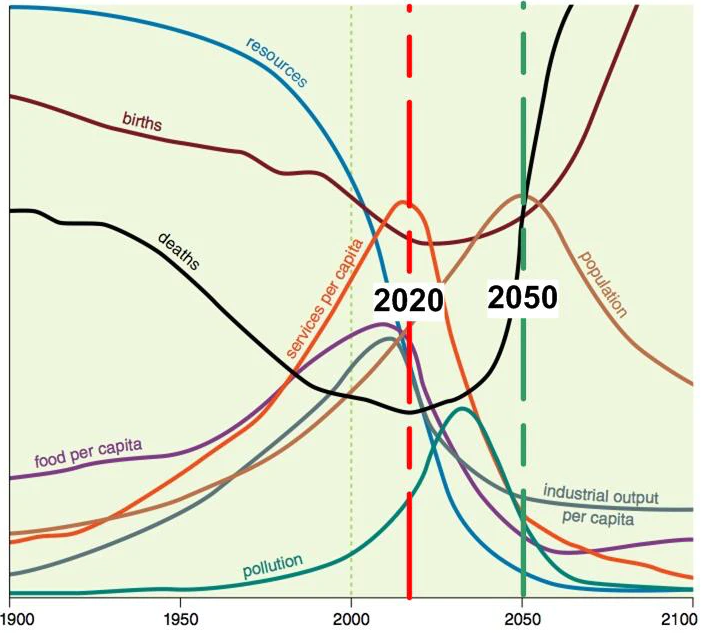 Notice that food per capita line. Remember all the screaming about fertility rates and look at the births line (though I think the collapse is more severe than modeled.) Industrial output is still increasing, as the chart suggests, but China’s about to go over a demographic ledge and I expect it will peak within ten years of the chart’s prediction. Resources are very definitely being depleted, though less fast than predicted. Still, it’s happening. Just read in detail about oil production.