The horizon is not so far as we can see, but as far as we can imagine

Tag: Oligarchy

The Structural Incentives Of Western Capitalism Make Competing With China Impossible

JoeQuant’s an ex NY finance guy who moved to Hong Kong. This tweet makes an important point:


He then goes on as follows:

One reason China is “winning” is that if you are a Western auto company, and you make extra money, you will put it into exec bonuses and shareholder buybacks. If you are a Chinese company, you realize that if you don’t put money back into the company, then the competition will eat you alive. At that point as a shareholder or exec you wonder how much is enough. What if I cut my salary to 2 million USD rather than 10 million USD and put the rest into R&D or worker salaries.

Yes.

The reason VW and other German firms made so much money in China for so long is that they had, brace for it, better cars. More technologically advanced. Better handling.

But, as Joe points out, they didn’t try and keep that lead. They let the Chinese beat them by refusing to properly re-invest their profits.

This is a constant problem in the West: our elites don’t want to compete on price. They don’t want to compete on quality. They want “moats” — they want monopoly profits just for existing.

The problem is that in most industries China doesn’t allow moats. It forces competition. It wants competitive markets. Chinese capitalism is actually what Americans think American capitalism is: red of tooth and claw. In America the Red Queen’s race is “make more money so you can buy more companies and make sure you can’t be bought”, in China it’s “keep ahead of real competition which is trying to have better quality cheaper products.”

I wrote a fairly long article on Germany’s tax and industrial policy earlier this year. The short of it is that they changed the incentives to make it easier for German firms to pay more divdends and do my buybacks, and so that investing outside the country made more sense than investing inside the country.

Then they got exactly what they deserved. Now, since they’re not competitive, they’re starting to switch their automotive industry over to military production.

And no, that won’t end well.

I continue to note that it appears that only communists and socialists seem to understand how to use markets to actually produce widespread prosperity. Capitalists should never be allowed to run markets, because capitalists always want to destroy the markets. The government must always view capitalists as greedy stupid children who must be supervised with heavy application of the rod, because the minute capitalists get rich, they want to end competitive markets. This is logical, in competitive markets no firm is ever secure, no fortune is ever impregnable.

Only oligarchy is safe for oligarchs. Unfortunately oligarchy destroys nations. Why is the US getting its ass kicked? Because it got rid of its industry. It’s that simple. It can’t even produce enough weapons any more, and essentially every industry in effectively an oligopoly–set up to raise prices faster than wages and entirely opposed to actual price and quality competition.

The CPC, not being capitalists, understand that capitalists are stupid, venal scum who must have fist of the state around their throat at all times.

The West used to understand that capitalists needed regulating, especially during the New Deal era. But they never truly understood that capitalists are like powerful nobles. If you don’t keep the boot on their neck, they will destroy you. And so they did and so they have, we’re just playing out the end results of oligarchs taking over the West: all the sound and fury and deaths are just part of an inevitable end-game. The actual damage was done in the 70s thru 90s (people can quibble about the dates) and the rest is just consequences.

If you want free markets, you need people who don’t trust capitalists in charge, and you need to be sure capitalists never capture the government. The second they do, your country is cooked. Depending on how prosperous it was before the oligarchs took over, it may take a few generations, but the end result is not in doubt.


What I write here is for the benefit of everyone, but alas, I live in capitalism and I, and the site, take money to keep running. If you value the writing here and can, please subscribe or donate.
Trade Is Not The Primary Driver of Currency Rates

The misunderstandings packed into this little bit of writing are stupendous:

Over the past few years, China has been in deflation, while the US has been in inflation. Yet despite this stark divergence, the CNH has still depreciated more than 10% against the US dollar. This combination — falling relative prices in China and a weaker currency — has made Chinese goods and services extraordinarily cheap in global terms. A vivid example: a night at the Four Seasons Beijing costs roughly $250, compared with more than $1,160 in New York

First, a 10% drop does not make a hotel room cost one quarter as much in Beijing as in New York. That’s ridiculous on the face. Almost everything costs less in China than in America. America has an economy optimized to drive prices high to extract maximum profit. China has economy with actual competitive markets: if you raise prices someone else will come in underneath you. Almost all of America is operating in or as if it is in an oligopoly. There is little actual price competition because even when there are competitors they figure that competing on price is stupid: it hurts both of them. Why not both raise prices to usurious heights? Win/Win.

This doesn’t happen in China because it has competitive markets and it has competitive markets in large part because China will throw executives in prison or execute them if they engage in this sort of price collusion, whereas in the US, though ostensibly illegal based on the laws on the book, such collusion has been made legal by decades of court decisions and prosecutorial decisions. (Prosecutors mostly don’t, and when they do courts almost always refuse to convict.)

China also has lots and lots of firms and genuine low barriers to entry. If you try to collude, someone from outside your industry will enter and undercut you, and often this will be someone with deep enough pockets that you can’t win a price war with them.

Second, currency values outside of hyperinflation are driven primarily by demand for currency. That isn’t primarily about trade, it’s about investors and financial carry trade. China unquestionably has a more dynamic and larger economy than any Western nation, but it isn’t financialized: Chinese companies don’t produce the sort of returns that American companies have over the last 50 years. This is deliberate policy: if they did, then China’s economy would suck for ordinary people, like Western economies suck for ordinary people because prices would be much higher. (See that Hilton room, though it cascades thru the entire economy, with rent and food at the low end much cheaper in China too.)

It is also pretty hard to invest in China as a foreigner, while the US is set up for foreign investors. Even if you want “China exposure” it’s hard to get.

So the Yuan isn’t in massive demand, because there aren’t bullshit over-sized returns like the AI bubble. The central bank doesn’t run its policies based on “the stock market must always go up.” America has spent 50 years burning down its real economy to produce outsize “profits” due to asset pumping. China keeps asset prices under control, and when a bubble does occur, as it did in real-estate, they deliberately deflate it, bearing the cost.

None of this is particularly unique, by the way. It’s basically the way the US economy was mostly run from the 30s thru the mid 70s or so. The policy details, the ways things are done are different, but American policies were meant to encourage real economic growth and if you look at a stock market graph you’ll see it traded sideways. No 50 year bull market. Asset bubbles were discouraged. You can’t have a good economy with high real-estate prices, just can’t be done and the stock market is a secondary market, not a primary one. Emphasizing it is sheerest insanity.

There is very little that China has done which is genuinely unique, despite jingoistic assertions otherwise. The playbook they have run is the same one almost every successful industrializing nation after Britain used, and very similar to the Japanese model. What is different are two things. First, the scale, when 1.4 billion people industrialize and modernize, it shakes the world. Second, a genuine desire to help the poor, which is extremely rare during industrialization, though not unheard of. (The Gilded Age did not care about the poor. Britain’s industrialization period was driven by hurting the poor as much, or more, than they could bear. They were far better off as peasants than in factories.)

Anyway, countries can be real rich (lots of genuine productive capacity with low prices and dynamic markets) or they can be fake-rich, with financialized markets that squeeze the last penny out of consumers and immiserate workers, leading to non-competitive markets and oligarchy. China is rich. America is fake-rich.


This site is only viable due to reader donations. If you value it and can, please subscribe or donate.

The Red Queen’s Race, Neoliberalism & Why Healthcare Is Being Privatized

Back in the early 2000s I remember reading an interview with Ted Turner, who founded CNN and later sold it. He wasn’t happy with how it was being run so the reporter asked him why he didn’t buy it back.

He explained that he had only a few billion dollars, which meant he wasn’t “in the game” anymore. People mocked him for it, since to a normal person that’s more money than they could ever use, but he was right. He had sold, and now he couldn’t re-buy; prices for key assets like CNN had gone up.

This the basic issue the real players, the mega-rich and the CEOs who run the big companies face. The amount of money that was enough last year isn’t enough this year, let alone in five years. Fall behind and soon you’re out of the game. This doesn’t have to be personal money, just money you control, so if you have effective management control of a company you don’t have ownership control of, you’re in the game, though such people generally reward themselves massively, so they at least aren’t embarassed in front of their peers.

Different oligarchs are competing against each other and so are different groups: tech, finance, manufacturing, military-industrial, etc…  If one gets enough of an advantage, then they buy out the others, and even if you’re still filthy rich, you’re out of the game and nowhere near as powerful as those still in the game.

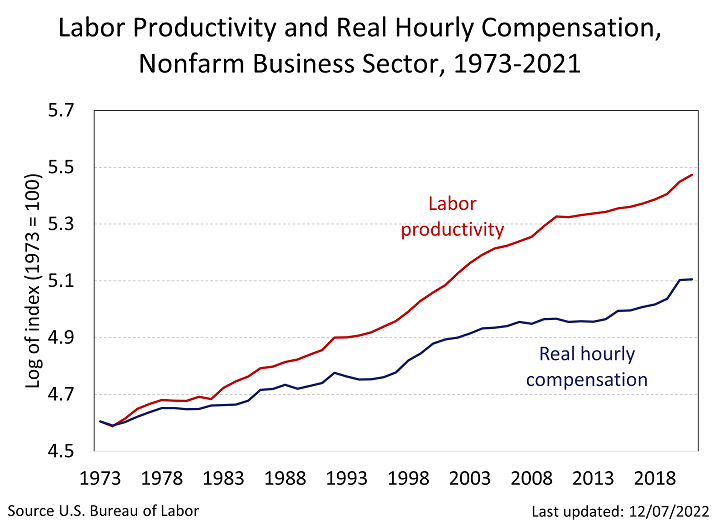
As everyone knows now, the rich have been taking more and more of pie. The most famous chart is the labor productivity vs. wages one:

Furthermore, the real players have been narrowing: there are fewer and fewer people who are really in the game. Vast waves of consolidation in almost every industry have created oligopolies and monopolies, because those sorts of businesses can squeeze customers. Some games are easier to squeeze than others: healthcare is a famous example as people will pay almost anything to live. There’s a reason Bill Gates is buying up all the farmland he can get, too, with environmental disaster onrushing, he knows that those who control food will (with enough political cover) also clean up.

But at the end of the day, everyone is taking from the same pool: any increase in wealth that doesn’t come from productivity increases has to come from someone else. The rich do take from each other, though they play by the rule that unless you’ve betrayed other elites  you get to stay wealthy, but most of what they take still has to come from the masses.

Unfortunately they’ve been squeezing the masses for 40 to 50 years, maybe a little more. So they have to keep finding new places to squeeze. This is why power has been privatized and de-regulated; why water and sewage is privatized in the UK (and sewage is in the rivers again), and so on.

But in those countries with public health systems (aka. not the US) like Canada and the UK, well, that’s a place where the full squeeze hasn’t been put on. Prices can easily be raised, by moving to the profit maximizing price (insulin at $800, like in the US, and so on), though it means a lot of people will suffer and die.

There’s one last big public heifer to be taken down and consumed, in other words. And if you don’t get in on it, well, your rivals will and they’ll be richer than you, and you stand a good chance of being forced out of the game.

So, with a few exceptions (manufacturing used to be one of them), the elite consensus is to privatize health care. It’s a big cow, sitting there waiting to be chopped up, and if you get a big enough chunk you may be able to buy out some rivals or at least stay in the game.

And in some cases it’s pretty much the last one. In the UK, it’s the only thing of worth the government owns which it hasn’t privatized. So, as everyone understands by now, you deliberately underfund and sabotage it, then call in the private sector because it isn’t working well. The same thing is happening in multiple Canadian provinces, including where I live in Ontario.

And the real players will become fewer and fewer, and if it means that you die or suffer, well, that’s a price the players are willing to pay so they can stay in the game.

As the game narrows, the players will also turn even more on each other. This has already happened with the TransAtlantic elite, who used to more or less cooperate: the US is now feasting on Europe. But then the Germans had been feeding on much of the rest of Europe already. And it’s obvious that Chinese and US elites are moving to a confrontation, and this is driven in great part by the refusal of the CCP to allow anything important in their economy to be controlled by foreigners.

Sadly, there is a real economy, and it is being fantastically mismanaged, not least by allowing the real carrying capacity of the world to collapse. Elites had such a huge pie (to change metaphors) that it usually made more sense to fight over it than to cooperate to grow it more. So we’re at the beginning stages of collapse. There will come a time when the pie starts to shrink in ways no one can deny.

The silver lining, such as it is, is that so much will have been privatized and screwed up that when we finally do get serious about change, assuming we avoid a Dark Age (not a sure thing) we will be able to do things differently, since there will be so little legacy left.

It’s not much of a silver lining, but destruction does make change possible.


The results of the work I do, like this article, are free, but food isn’t, so if you value my work, please DONATE or SUBSCRIBE.

Obama Starts to Cash In

It took Bill and Hillary years to get to 100 million. The Obamas, well…

Barack and Michelle Obama have sold the rights to their next books to Penguin Random House for a sum that has reportedly passed $60 million, according to a report by the Financial Times. (They will be writing separate books, but the rights were sold jointly.) As far as past and present presidential book deals go, this one’s a biggie: It surpasses previous records set by George W. Bush’s reported $7 million deal and Bill Clinton’s reported $15 million dollar advance.

Penguin-Random House, of course, is the result of a merger that Obama’s administration should not have allowed.

I’m waiting for the speeches, those should be wonderful.

I think this is only fair, though. Clinton may have carried water for the rich, but Obama played a huge part in making sure that they didn’t lose all their money after the financial crisis (yes, Bush and Bernanke started the bailouts, but Obama had them all by the short and curlies and could easily have put almost every senior executive in the financial industry in prison for fraud, and could have spiked large parts of the bailouts had he chosen to do so.)

This is why I don’t get very worked up about Trump’s conflicts of interest. They are real, but the only difference is that he’s getting paid now as opposed to later. Politicians exist to do what rich people want, Trump is only cutting out the middle man and the partial delay.

This is an important point, and I want to encourage you to read this longer article on how politicians are paid by rich people to fuck over ordinary people. It’s not about donations for elections.

Obama continued the trend, which has gotten worse for decades, of the rich getting more and more of all the gains of the economy. He did not try, in any way, to reverse it. And that’s because he knew he was being paid to funnel money to the rich. That was his job, he did it, and now he is getting his reward.


The results of the work I do, like this article, are free, but food isn’t, so if you value my work, please DONATE or SUBSCRIBE.

Powered by WordPress & Theme by Anders Norén